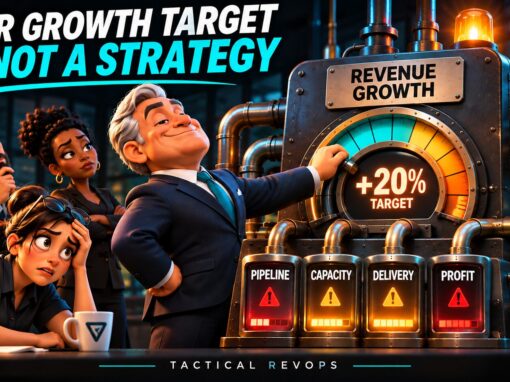
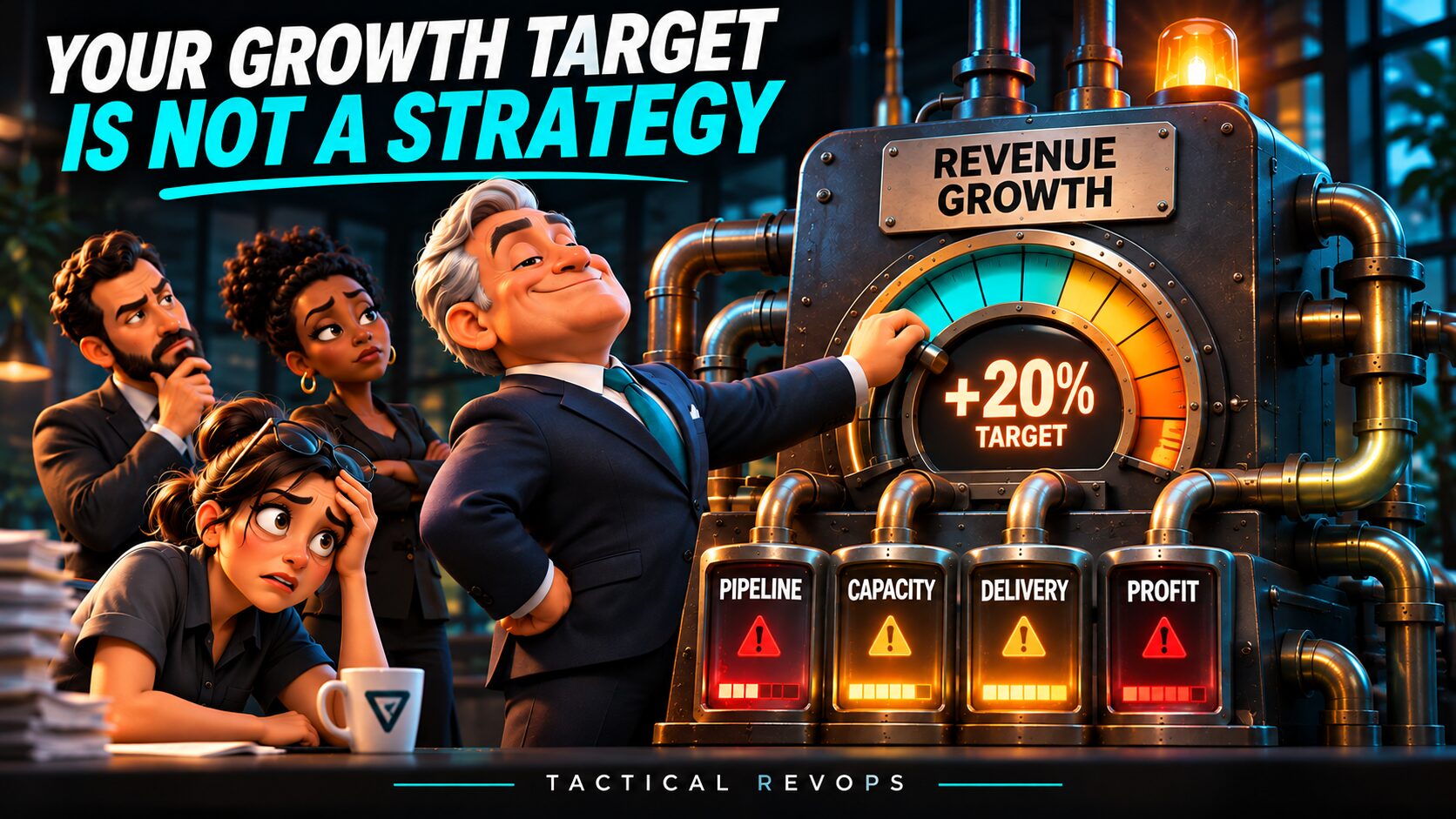
Why a 20% revenue growth target isn’t a strategy—and how to build a plan your business can actually execute.
It’s that time of year again. Leadership teams are reviewing performance, building budgets, and setting ambitious growth targets for next year. Maybe the CEO wants 20% revenue growth. Maybe private equity expects 30%. Maybe the number came from a carefully developed financial model—or maybe someone just decided that’s what the business needs to deliver. Either way, the conversation usually starts with the same question: “How much do we want to grow next year?” But there’s a much more important question that should come first: “Where is that growth actually going to come from?” More new customers? Larger deals? Higher prices? Existing customer expansion? New products or services? Acquisitions? And just as importantly, does your organization have the people, processes, data, and tools necessary to make it happen? Because setting a revenue target is easy. Building a commercial operation capable of delivering it is something else entirely.
Start by Understanding How You Make Money
Before you start building next year’s sales plan, you need a clear picture of how your business generates revenue today. For B2B service organizations, revenue rarely comes from a single source. You might have a combination of:
- New customer acquisition: Winning business from customers you’ve never served before.
- Existing customer expansion: Selling additional services, projects, or solutions to customers you already have.
- Recurring or repeat business: Renewals, maintenance contracts, ongoing services, or repeat project work.
- Pricing improvements: Increasing revenue through higher rates, improved pricing structures, or better contract terms.
- New offerings or markets: Introducing additional services, expanding geographically, or entering new industries.
- Acquisitions: Adding revenue through inorganic growth.
Each of these growth levers operates differently. They require different investments, different capabilities, and different timelines. And yet, I regularly see companies lump everything together into one big revenue target and expect the sales team to figure out how to get there. That’s not a plan. That’s a wish.
Reverse-Engineer the Growth Target
Let’s use a simple example. Your company generated $20 million in revenue this year. Leadership wants 20% growth next year. That means you need to generate $24 million. Your growth gap is $4 million.
Now the real planning begins. Instead of simply assigning everyone a 20% higher quota, break that $4 million into its potential sources.
| Growth Lever | Incremental Revenue |
|---|---|
| New customer acquisition | $1.5M |
| Existing customer expansion | $1.0M |
| Additional recurring services | $750K |
| Pricing improvements | $500K |
| New offerings or markets | $250K |
| Total Growth | $4.0M |
Illustrative example only. Actual growth assumptions should be based on historical performance, market opportunity, and organizational capacity.
This assumes your existing $20 million revenue base remains intact. In reality, you also need to account for customer churn, completed projects that won’t repeat, contract reductions, and other revenue at risk. If you’re expecting to lose $1 million in existing revenue, you don’t need $4 million in new growth. You need $5 million just to reach your $24 million target. Now you have something to work with.
But we’re still not done. These are revenue assumptions—not execution plans. The next step is figuring out what must actually happen to deliver each one.
Translate Revenue Goals into Commercial Activity
Let’s take that $1.5 million new customer acquisition target. If your average new customer generates $150,000 in first-year revenue, you need approximately 10 new customers. Simple enough.
But how many qualified opportunities does it take to win 10 customers? If your historical win rate is 25%, you need roughly 40 qualified opportunities. And if only 20% of your leads become qualified opportunities, you need approximately 200 leads. Suddenly, that $1.5 million target becomes a much more tangible commercial requirement:
- 200 leads
- 40 qualified opportunities
- 10 new customers
- $1.5 million in first-year revenue
Now you can start asking meaningful questions. Can Marketing generate 200 relevant leads? Does Sales have the capacity to work 40 opportunities effectively? Is your historical 25% win rate realistic for the customers you’re targeting? How long does it typically take to move an opportunity from initial interest to Closed Won? And perhaps most importantly, when will those new customers actually start generating revenue?
Bookings, recognized revenue, and cash flow are not interchangeable. For project-based and service organizations, a contract signed in October may not contribute much recognized revenue until the following year. And a $150,000 contract doesn’t necessarily mean $150,000 in revenue this year. Your conversion math needs to account for the timing and value of revenue recognition—not just the number of deals you expect to close. If you’re building an annual revenue plan based on sales bookings without accounting for delivery timelines, you’re going to have a problem.
Your Next Year’s Revenue Is Already Partially Determined
Here’s something that often gets overlooked during annual planning. For businesses with long sales cycles, a significant portion of next year’s revenue potential is already sitting in your pipeline, backlog, and existing customer relationships. You can’t necessarily manufacture another $4 million in revenue by deciding to prospect harder in January. If your average sales cycle is nine months and your delivery cycle takes another six months, opportunities created in January may not generate meaningful recognized revenue until the following year. That means your annual plan needs to start with what you already know. Look at:
- Contracted backlog: Revenue already sold but expected to be recognized next year.
- Existing pipeline: Open opportunities, their realistic likelihood of closing, and expected delivery timelines.
- Recurring and repeat revenue: Existing contracts, renewals, and reasonably predictable customer demand.
- Revenue at risk: Contracts expiring, projects ending, customers reducing spend, or other expected declines.
- New pipeline requirements: Additional opportunities needed to close the remaining gap.
This creates a much more realistic starting point. For example, if your $24 million target includes $15 million in contracted backlog and reasonably expected repeat revenue, you need to determine where the remaining $9 million will come from. How much can realistically come from your current open pipeline? How much requires opportunities that don’t exist yet? And will those new opportunities have enough time to close and generate revenue within the planning year? This is where understanding sales cycle duration, conversion rates, and revenue timing becomes critical. A pipeline that looks large on paper doesn’t necessarily translate into revenue when you need it.
Don’t Forget the Customers You Already Have
New customer acquisition tends to get most of the attention during growth planning. It’s exciting. It’s measurable. And it’s easy to rally a sales team around winning new logos. But for many established B2B service companies, the most accessible growth opportunities may already exist within their customer base.
Consider a company that has hundreds of existing customers across multiple service lines. How many of those customers know everything the company offers? How many are purchasing from only one division? How many have aging equipment, upcoming capital projects, or additional facilities that could benefit from other services? And how many haven’t heard from anyone on your team since their last project was completed? This is especially relevant for PE-backed companies pursuing a buy-and-build strategy.
Acquiring additional businesses creates the potential for cross-selling. But simply putting multiple companies under one ownership structure doesn’t automatically create a unified commercial organization. You need visibility into customer relationships, purchase history, installed equipment, service opportunities, and account ownership. Then you need a repeatable process for identifying and pursuing expansion opportunities. Otherwise, all those projected cross-selling synergies remain exactly that—projections. And if existing account growth is supposed to contribute $1 million to your plan, someone needs to own that target, identify the opportunities, and establish the activities required to deliver it.
Revenue Growth Isn’t the Same as Profitable Growth
There’s another important consideration, particularly for PE-backed businesses. Not all revenue growth creates the same value.
A company can hit its revenue target and still miss its EBITDA expectations. Maybe new customer acquisition costs increased significantly. Maybe the business had to hire additional salespeople, engineers, or delivery personnel to support the growth. Maybe margins deteriorated because the team discounted aggressively to win new projects. Or maybe the company pursued lower-margin work simply to hit its top-line target. That’s why your growth plan needs to consider both revenue and profitability. For each growth lever, ask:
- What gross margin do we expect?
- What additional resources or operating expenses are required?
- How much will customer acquisition cost?
- Can we deliver the additional work efficiently?
- Does this growth contribute to our EBITDA objectives?
For example, $1 million in new revenue at a 15% gross margin is fundamentally different from $1 million at a 40% gross margin. And even gross margin doesn’t tell the whole story if one strategy requires significant additional sales and marketing investment. The objective shouldn’t simply be to grow revenue at any cost. It should be to understand which growth opportunities create the most value—and what operational investments are required to capture them. For PE-backed companies, this is especially important because predictable, profitable growth is what ultimately supports enterprise value.
Make Sure You Have the Capacity to Deliver
Here’s another mistake I see in annual planning. Leadership increases revenue expectations without evaluating whether the organization has the capacity to support them. Sometimes the assumption is that existing salespeople will simply sell more. But what if they’re already spending most of their time managing existing accounts, preparing proposals, coordinating technical resources, and supporting project delivery? Adding a higher quota doesn’t magically create more selling capacity. And hiring more salespeople doesn’t necessarily solve the problem either. If Marketing isn’t generating enough demand, if engineering can’t turn around proposals, or if delivery teams are already at capacity, adding sales headcount may simply move the bottleneck somewhere else. You need to understand the operational constraints across the entire revenue engine.
Sales capacity: Do you have enough people to generate and manage the required pipeline? Are they spending time on the right activities?
Marketing capacity: Can Marketing generate the necessary demand? Are there clear target markets, campaigns, and lead management processes?
Technical and proposal capacity: Can engineering, estimating, or solution development teams support the additional opportunity volume?
Delivery capacity: Can your organization fulfill the additional business without compromising quality, customer experience, or profitability?
Systems and data: Can you reliably measure pipeline, conversion, account growth, and performance against the plan?
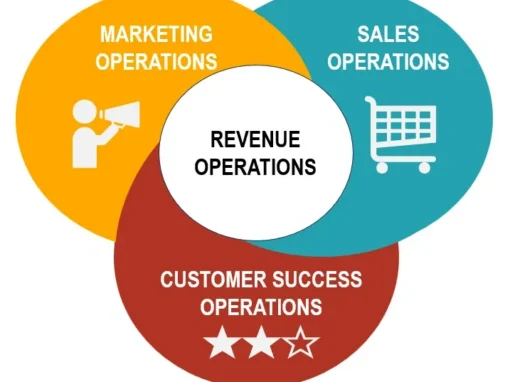
This is where Revenue Operations becomes especially important. Growth isn’t exclusively a Sales problem. It’s a cross-functional operating challenge. And if one part of your team can’t keep up, the entire plan is at risk.
Build a Plan Around Leading Indicators
Revenue is a lagging indicator. By the time you realize you’re missing your annual revenue target, many of the decisions that created the shortfall happened months earlier. That’s why effective growth planning requires more than a revenue dashboard. You need to identify the leading indicators that tell you whether your commercial engine is producing the results required. Depending on your business, those might include:
- Qualified pipeline created by source, segment, or business unit
- Pipeline coverage against future bookings targets
- Lead-to-opportunity and opportunity-to-win conversion rates
- Average deal size and sales cycle duration
- New customer acquisition and existing account expansion
- Proposal volume and turnaround time
- Backlog, delivery capacity, and expected revenue timing
- Gross margin and profitability by customer, service line, or project type
Not every company needs to track every metric. The goal isn’t to build the world’s most complicated dashboard. It’s to identify the handful of metrics that actually explain whether your business is on track—and give leadership enough time to intervene when it isn’t. If your sales cycle averages nine months, discovering in September that you don’t have enough qualified pipeline to hit December’s revenue target isn’t particularly helpful. You needed that information months ago.
Turn the Financial Target into an Operating Plan
This is the fundamental difference between budgeting and operational planning. Finance can establish the revenue and EBITDA targets. But those targets need to be translated into the commercial activities, resources, and processes required to deliver them. A financial plan tells you what the business needs to achieve. An operating plan tells you how the business intends to achieve it. And that requires alignment across functions. At a minimum, leadership should be able to answer five questions:
1. Where is growth expected to come from? Define the revenue contribution expected from new customers, existing accounts, recurring business, pricing, new offerings, and acquisitions. Account for revenue at risk and avoid double-counting growth assumptions.
2. What activities and conversion assumptions support those targets? Use historical performance wherever possible. Understand the pipeline volume, win rates, sales cycles, average deal sizes, and delivery timelines required.
3. Who owns execution? Establish clear accountability across Marketing, Sales, Account Management, Finance, and Delivery. If everyone owns growth, but nobody owns the individual growth levers, execution becomes inconsistent.
4. What capacity or investment is required? Identify staffing, enablement, technology, and process gaps before they become bottlenecks. Evaluate the cost and expected profitability of each growth initiative.
5. How will we measure progress? Build dashboards and a management cadence around the leading indicators that matter. Review performance, challenge assumptions, and adjust the plan as conditions change.
Then make this part of how the organization actually operates. A good annual plan shouldn’t get filed away after the budget is approved. It should drive quarterly priorities, monthly performance reviews, weekly sales and marketing activities, and the decisions leadership makes throughout the year. Markets change. Deals slip. Customers delay projects. New opportunities emerge. A good operating plan isn’t rigid. It gives leadership the visibility to make adjustments before small problems become missed annual targets.
The Bottom Line: A Growth Target Is Not a Growth Strategy
I’m all for ambitious goals. Especially in PE-backed organizations, where growth expectations are high and the pressure to deliver is real. But ambition needs to be supported by operational reality. Before you tell your team to grow revenue by 20%, understand how your revenue engine actually works. Know where revenue comes from, what drives conversion, how long it takes to materialize, and what resources are required to deliver it profitably. Understand what your existing backlog and pipeline can realistically produce—and how much additional demand you need to generate. Then build a plan around those realities.
Finance sets the target. Revenue Operations helps determine whether the business can actually deliver it.
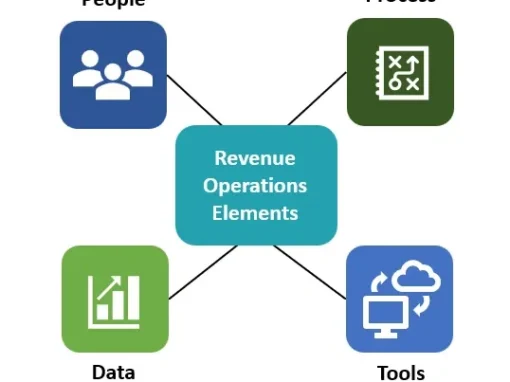
Because predictable growth doesn’t come from setting bigger targets. It comes from building a commercial operation capable of consistently delivering them. And that’s exactly where Tactical RevOps comes in. We help growing B2B companies connect their revenue strategy to the people, processes, data, and tools needed to execute it. If you’re heading into annual planning and aren’t confident your commercial engine can support next year’s growth expectations, let’s talk.