Merging the CRM Is the Easy Part
You acquired a company. Congratulations!! Now someone has to figure out what to do with their CRM—or their spreadsheets, Smartsheets, Monday.com boards, legacy systems, and all the tribal knowledge they’ve accumulated over the years.
On paper, the next step sounds simple enough: get all of that data into your CRM. Export the files, map the fields, import everything into Salesforce or HubSpot, and move on.
But moving the data is usually the easy part. The harder—and more important—work is figuring out what information is worth preserving, how the combined organization should operate, and how you’re going to turn all of that acquired customer history into something your commercial team can actually use.
Before you start importing records, here are five things worth thinking about.
1. Your CRM Is a Relationship Tracker, Not Just a Deal Tracker
This is the first mindset shift. A lot of companies are pretty good at tracking transactions. They know they sold a $475,000 project to ABC Manufacturing three years ago. Great. But who bought it? Who evaluated it? Who approved it? Who uses it today? Who does your salesperson actually call when they want to talk about the next project?
This is where acquired data can get surprisingly thin. You may find years of Accounts and Opportunities with very few Contacts associated with them. If the answer to who knows the customer is, “Oh, Steve knows everyone over there,” that’s not really a customer relationship management system. That’s Steve.
During an acquisition, that distinction matters. People leave, territories change, responsibilities shift, and sales teams combine. The person who has managed an account for ten years may not be the person responsible for it six months from now. If the relationships only exist in someone’s inbox, phone, or head, you’re at risk of losing a huge amount of commercial knowledge during the transition.
So don’t just migrate transactions. Preserve the relationships behind them. I like two simple rules: no orphan accounts and no orphan opportunities. Every meaningful customer account should have an actual person associated with it, and every meaningful opportunity should tell you who was involved.
A CRM should tell the next person who inherits an account more than “We sold them something for $475,000 in 2023.” It should help them understand who we know, what they bought, and where the relationship stands today.
2. Define the Process Before You Build It
An acquisition is not the time to blindly recreate every legacy sales process inside a new CRM. It’s an opportunity to ask a better question: How should the combined company operate going forward?
Start with the fundamentals. What are your opportunity stages, and what does each stage actually mean? What has to happen before a deal moves forward? What constitutes Closed Won? What date are you forecasting against? Who owns accounts and opportunities? What information should be required? How will the combined organization forecast?
But be open-minded during this process. You may discover that one company has a process the other doesn’t. Maybe one organization manages partners differently. Maybe one tracks installed equipment or assets. Maybe one has a formal lead qualification process and the other doesn’t. Maybe neither company has a good process for contracts, renewals, customer success, or cross-selling.
That’s okay. You don’t have to preserve every process simply because it existed before the acquisition, and you shouldn’t assume the acquiring company’s process is automatically the right answer either.
Use the integration as an opportunity to identify what’s working, what’s missing, and what the combined organization actually needs. Don’t just automate the way you’ve always worked. Build the process you need for where you’re going.
3. Clean Your Data Before You Move It
A CRM migration does not fix bad data. It relocates it. If you have duplicate accounts, missing contacts, outdated owners, incorrect opportunity amounts, inconsistent company names, and blank close dates in a spreadsheet, importing all of that into Salesforce or HubSpot doesn’t suddenly make it good data. Now you just have dirty data in a more expensive system.
Take a pass at it before you migrate. Deduplicate what you can, standardize company names, validate contact information, identify former employees, confirm important dates, validate opportunity amounts, fill obvious gaps, and enrich Accounts and Contacts where it makes sense. You should also decide which source is authoritative when two systems disagree.
AI and enrichment tools can make this process significantly easier. They can help identify duplicates, standardize information, categorize records, enrich companies and contacts, and flag anomalies much faster than doing everything manually. Use them—but don’t expect AI to magically fix everything.
AI can help clean information that exists. It can’t reliably reconstruct information your organization never captured. If nobody recorded the contact involved in a deal five years ago, AI doesn’t know that Susan in Engineering was the real champion, and it shouldn’t make one up.
Sometimes acquisition timelines mean you can’t get everything perfectly clean before migration. That’s fine. Move what you need to move, but make data hygiene an immediate workstream afterward. Otherwise, you’re starting your new CRM with years of inherited technical debt and wondering six months later why nobody trusts the reports.
4. Ditch the Spreadsheets—and Build the Discipline to Use Your CRM
One of the fastest ways to undermine a CRM rollout is to tell everyone the CRM is now the system of record and then ask them to keep updating the spreadsheet too. Now you’ve created two jobs for your sales team and two versions of reality.
The spreadsheet says the opportunity is worth $600,000 while the CRM says $450,000. One says it’s closing in October and the other says August. Eventually someone asks, “Which one is right?” Once people stop trusting the CRM, adoption gets a whole lot harder.
A migration needs a real cutover. Archive the old files, preserve what you need for historical reference, and keep something read-only temporarily if necessary. But decide where the business is going to operate and then actually operate there.
That also requires a shift in how CRM maintenance is viewed. Updating an opportunity shouldn’t be treated as administrative homework. Adding contacts isn’t busywork. Keeping a close date current isn’t something Sales does because RevOps keeps sending annoying reminder emails.
It’s commercial operating discipline.
If leadership wants an accurate forecast, someone has to maintain the information that produces that forecast. If you want visibility into customer relationships, someone has to capture those relationships. If you want useful dashboards, automation, marketing attribution, cross-sell reporting, or AI-generated insights, the underlying information has to stay current.
Technology can make that easier, but it can’t eliminate the responsibility. In fact, AI makes this discipline more important, not less. AI can summarize activities, identify patterns, recommend next steps, and surface opportunities, but it still needs reliable information to work from.
Garbage in, garbage out hasn’t disappeared. We’ve just gotten much better at analyzing the garbage.
5. Make Cross-Selling Measurable
Cross-selling is one of the most common ways companies expect to create value after an acquisition. You now have more customers, more products and services, and theoretically more opportunities to sell those offerings across the combined customer base.
Pretty quickly, someone is going to ask: How much cross-sell pipeline have we created? And eventually: How much cross-sell revenue have we actually won?
Your CRM needs to be able to answer those questions. That doesn’t necessarily require an elaborate new process or a separate type of opportunity. You can still use your normal Opportunity structure, but you need a consistent way to identify cross-sell opportunities, understand which part of the business originated the customer relationship, and report on the resulting pipeline and revenue.
This is also where Products and Price Books become much more important. I hear some version of “Products won’t work for us because everything we sell is custom” frequently, particularly in project-based, engineering, manufacturing, and services businesses.
Maybe the final solution is custom. That doesn’t mean everything about what you sell is unique.
You can still break your offerings into commercially meaningful categories: product families, services, solutions, equipment types, recurring offerings, or standard components. You don’t have to build the world’s most sophisticated product catalog on day one, and your CRM Price Book doesn’t necessarily need to replicate every possible configuration in your ERP. Start at the level that’s commercially useful.
Because “ABC Manufacturing — $475,000 — Closed Won” tells you a transaction happened. “ABC Manufacturing → Product Family A → $475,000 → Purchased 2025” tells you something much more useful.
Now you can start asking which customers buying Product A could also buy Product B, which legacy Company A customers haven’t purchased anything from Company B, and how much cross-sell pipeline and revenue the organization has created since the acquisition.
That’s when your CRM stops simply documenting what happened and starts helping you identify what could happen next.
Don’t Just Merge Systems. Build the Combined Commercial Operation.
A successful CRM integration isn’t measured by how many records successfully made it through the import. It’s measured by whether the combined company can actually use them afterward.
Can you identify the people behind your customer relationships? Can you hand an account to a new salesperson without needing a 30-minute explanation from the person who used to own it? Can you trust the pipeline and forecast? Can you tell what your customers have purchased, identify what else they could buy, and measure whether cross-selling is actually happening?
And most importantly, can your team get those answers from the CRM without someone saying, “Hold on. Let me check the spreadsheet.”
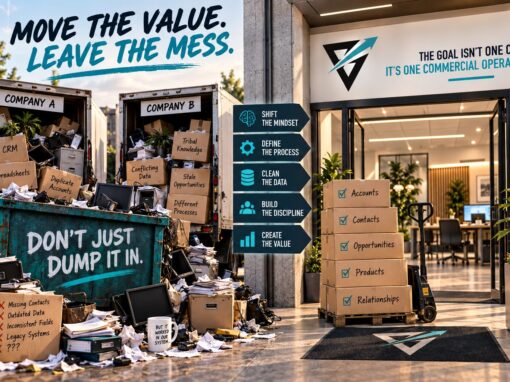
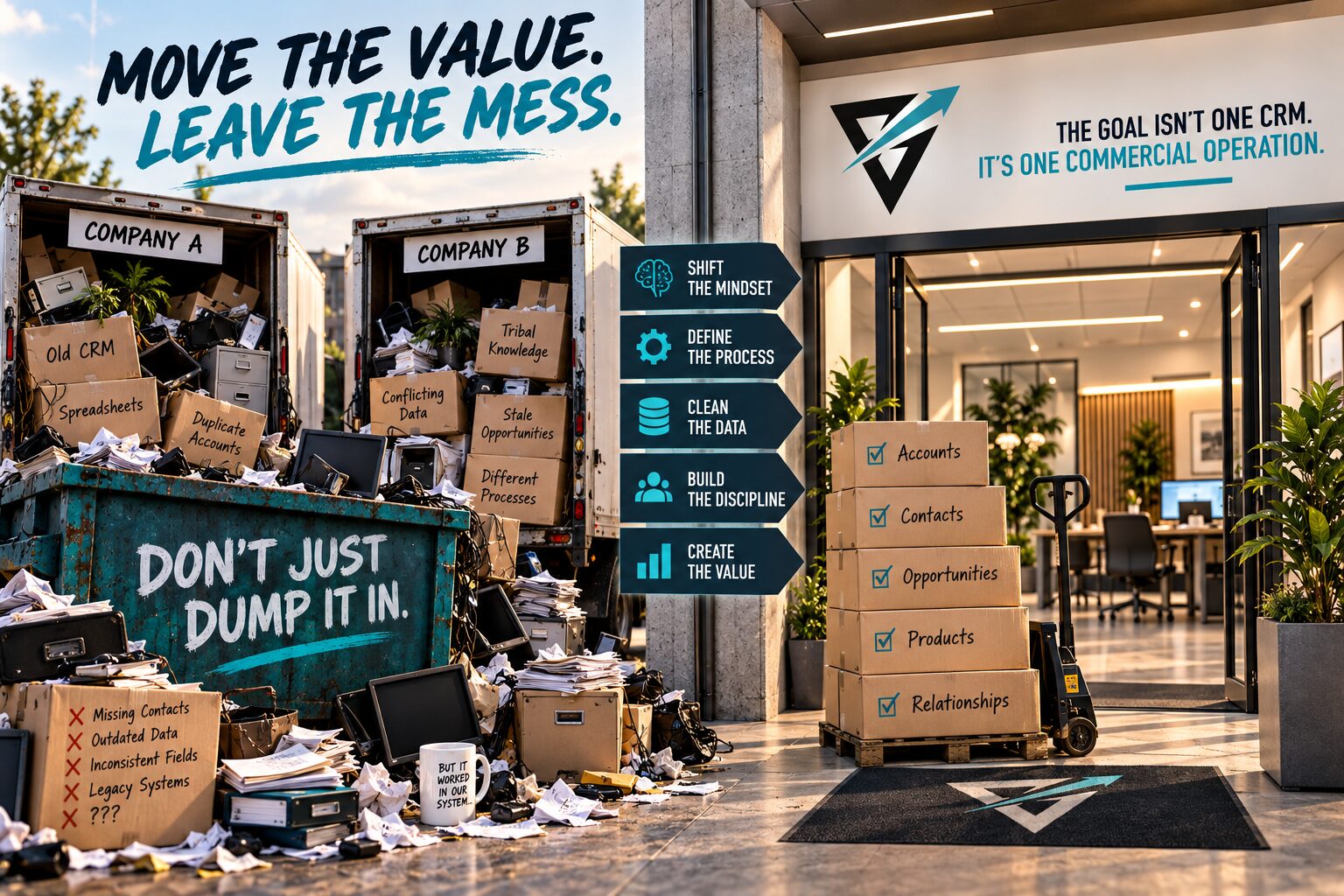
That’s the goal. Before you rush into your next CRM consolidation, think beyond the migration itself: shift the mindset, define the process, clean the data, build the discipline, and create the value.
The technical migration may be the easy part. Building one commercial organization that operates from the same version of reality is where the real work begins.