Why some deals were strong from the beginning — and others never really were
A lot of B2B sales advice assumes a clean, linear buying journey. There’s a decision-maker. There’s a budget. There’s a sales process. If you build enough value and differentiate clearly enough, you win.
That logic breaks down in regulated, project-based, or engineering-led markets.
Because in those environments, you are rarely selling to a single buyer. You are entering a structured buying system — one that may include engineers, procurement teams, general contractors, compliance officers, capital committees, and sometimes regulators. Each of them influences the outcome in different ways, and often long before your opportunity is formally recognized inside your CRM.
When companies struggle with unpredictable forecasts or sudden late-stage losses, it’s usually not because their team forgot how to sell. It’s because they misread the structure of the buying environment they were operating inside.
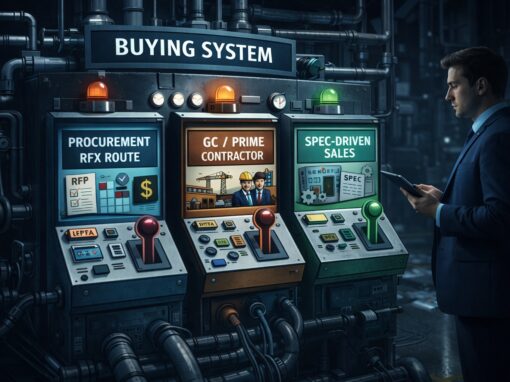
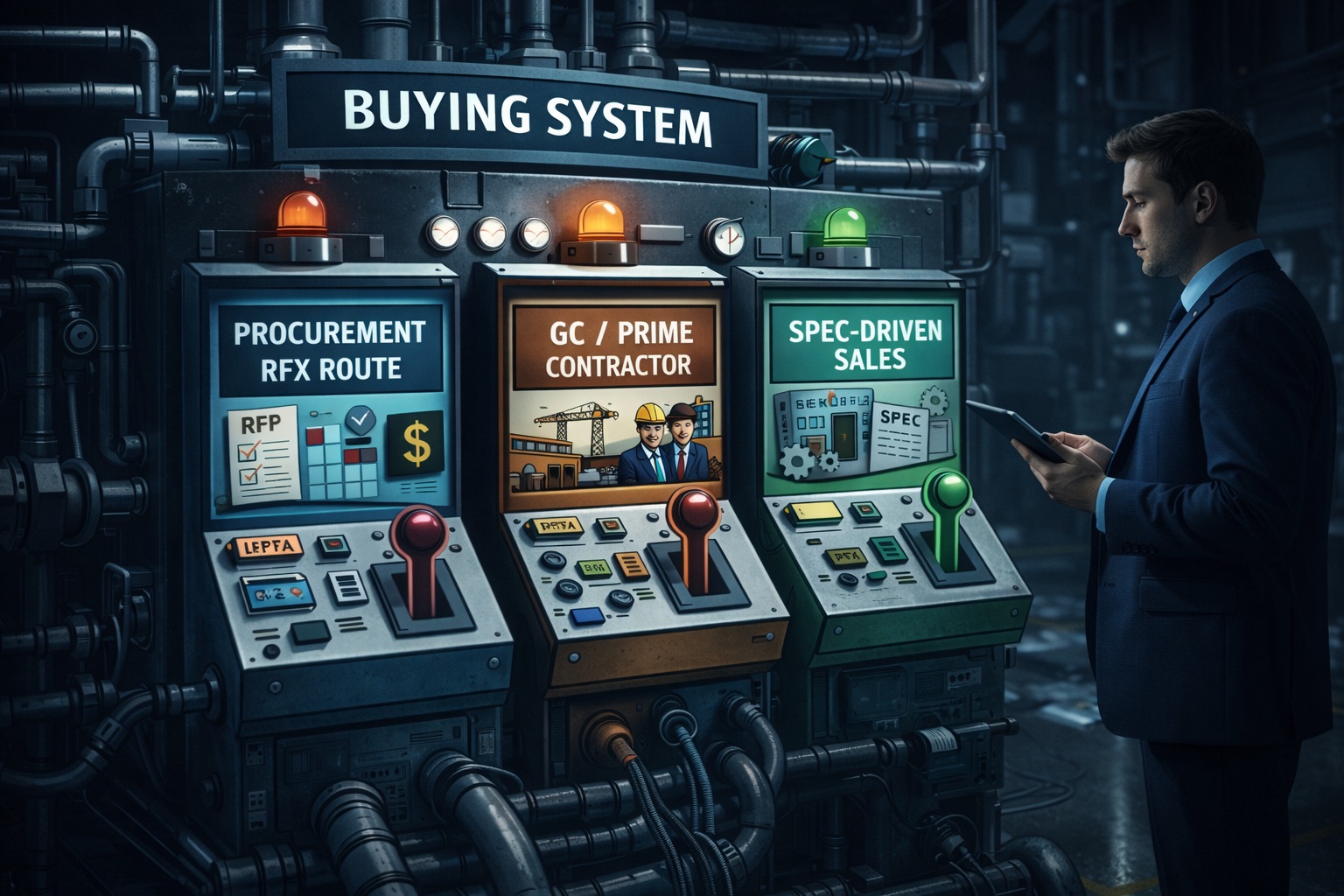
Across most service-led industries — construction, infrastructure, industrial services, healthcare systems, energy, utilities — three dominant buying structures show up repeatedly: procurement-led buying (often LPTA), subcontractor selling through a prime, and spec-driven sales. They operate differently, but they share a common feature: control is distributed, and leverage must be earned earlier than most teams realize.
LPTA and Procurement-Led Buying: When the System Is Designed to Flatten Differentiation
In procurement-led environments, the process is not built to reward storytelling or nuance. It is built to enforce fairness, documentation, and cost discipline. Whether in public infrastructure, healthcare systems, utilities, or industrial contracting, procurement exists to ensure compliance first and price competitiveness second.
In a formal LPTA structure, the sequence is binary. First, determine whether a vendor is technically acceptable. Then compare price among those who pass.
That framing matters more than most teams acknowledge. Once technical acceptability is defined and frozen, differentiation narrows dramatically. Experience, responsiveness, innovation, even long-term cost efficiency — all of it is filtered through a compliance lens. If you meet the threshold, you advance. If you exceed it, the excess may not carry weight.
The mistake many service firms make is treating this as a sales skill issue. They respond by sharpening pencils, trimming margin, or adding scope in hopes of “standing out.” But the structural reality is this: if you did not influence the definition of acceptable before the RFP was published, you are competing inside a compressed field by design.
That doesn’t make procurement-led markets unattractive. It simply means they must be classified honestly. An opportunity that begins at RFP release with no upstream influence is fundamentally different from one where requirements were shaped through prior engagement. If your pipeline doesn’t distinguish between those two, your forecast won’t either.
Subcontractor Selling: When Your Customer Is Not the One Writing the Check
In project-driven industries, layered contracts are the norm. An owner hires a prime contractor. The prime hires subcontractors. Those subcontractors may hire lower-tier vendors. Revenue flows through layers, and so does risk.
When you sell through a GC or a prime, your direct customer is not the ultimate economic decision-maker. That changes the nature of the opportunity. You are not just selling capability; you are selling into someone else’s margin structure and delivery risk.
From the prime’s perspective, every subcontractor represents both necessary expertise and potential exposure. Will they deliver on schedule? Will they create rework? Will they increase inspection risk? Will they hold up commissioning? Those concerns sit alongside price.
This is why inclusion on a bid is not the same as security. Being “selected” early can still unravel under value engineering pressure. Scope can be compressed. Vendors can be substituted. Numbers can be revisited at the eleventh hour.
Stronger operators recognize that leverage in this environment does not come from being liked. It comes from being difficult to remove. If replacing you introduces redesign, delay, compliance risk, or warranty complications, your position improves. If removing you simply saves cost with minimal disruption, you remain interchangeable.
Again, this is structural. Two identical revenue-sized opportunities can carry radically different risk profiles depending on whether you work directly with the owner or through a transactional relationship with a prime estimator. Treating those as equivalent inside your pipeline is not optimism. It’s distortion.
Spec-Driven Sales: When the Decision Is Made Before the Budget Is Approved
In engineering-led sectors — water, energy, industrial systems, healthcare infrastructure — technical preference is often determined during design, long before procurement formalizes the purchase. The visible buying event may be the RFP, but the structural decision frequently happens months earlier.
An engineering firm or internal technical team writes the specification. That document defines approved manufacturers, performance thresholds, testing requirements, installation criteria, and often basis-of-design language. By the time an RFP is released, much of the technical outcome has already been shaped. Procurement may run the process, but engineering has framed the solution set.
If your solution is named in the specification, you enter the bid process with gravitational pull. If you are competing as an “approved equal,” you enter from a fundamentally different position — one where you must displace an embedded preference rather than simply win on merit.
Many organizations categorize engagement with engineers as marketing or technical support — lunch & learns, whitepapers, technical presentations, webinars. In spec-driven markets, that’s a misclassification. The materially important moments occur much earlier and are far more structural: when you are influencing performance criteria, contributing to draft specification language, supporting capital planning assumptions, or participating in the technical and policy bodies that shape standards. Those activities may not look like pipeline, but they are often where pipeline strength is actually created.
The moment your solution becomes the basis of design, the opportunity has already shifted in your favor — even if revenue will not materialize for 12 to 24 months. If your organization only measures active bids and ignores upstream design influence, you will consistently undervalue your future competitive position and misunderstand why certain wins feel “easier” than others.
The Structural Thread That Connects Them
Across all three environments, the underlying issue is not sales effort. It is positional awareness.
Most CRM systems are built around stages and probabilities. They assume that as a deal progresses from qualification to proposal to negotiation, risk steadily declines.
In structured buying systems, that assumption can be false.
A late-stage LPTA bid may still be highly volatile.
A subcontractor opportunity may look advanced but remain vulnerable to value engineering.
A spec-driven opportunity may appear early but be structurally advantaged because the design is already aligned.
If you do not account for when you entered, who defined requirements, and how removable you are, you are not measuring opportunity strength. You are measuring motion. And motion is not the same as leverage.