Last week, I shared “5 Ways Tactical RevOps Engagements Fail.” But failure is only half the story. The other half is knowing what actually makes a RevOps engagement succeed.
From my experience, I’ve seen that successful RevOps engagements and projects don’t happen by chance. I’ve noticed a clear pattern: when things click, it’s because three big things are happening consistently. Let’s break them down.
1. Leadership Engagement Beyond the Kickoff
If you think your job as a leader ends after the kickoff meeting, think again.
RevOps succeeds when leadership is in the room, in the data, and in the conversations well beyond the launch. The most successful teams I work with have executives who:
- Check in regularly on progress and roadblocks.
- Communicate wins and reinforce priorities to their teams.
- Make space for the hard conversations when change gets uncomfortable.
It’s simple but powerful — people take change seriously when they see their leaders taking it seriously.
If leadership drifts away after the kickoff, RevOps quickly becomes “that ops project” gathering dust in the background. Stay visible, stay engaged, and you’ll be amazed at how quickly your teams align and adopt.
2. Commitment to the Process (No Quick Fixes)
Here’s the thing no one likes to hear: there are no quick fixes to build true scalable and consistent revenue growth.
Think about it — you wouldn’t expect to lose 20 pounds after one workout, or build a house in a week, or have a baby in three months. Successful Revenue Operations is the same. It takes time and consistency to analyze what’s broken, implement the right solutions, and stabilize them.
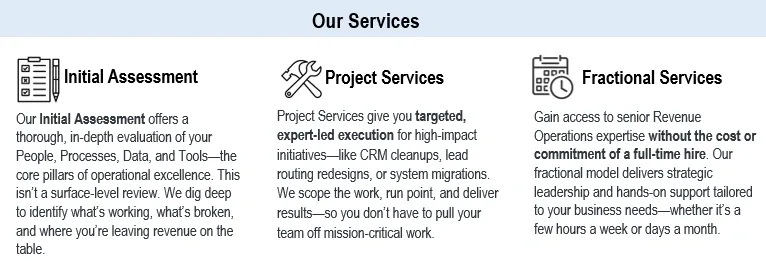
That’s why my fractional engagements start at a minimum of six months. It’s not about dragging things out; it’s about giving the work time to stick. When you commit to the process, you create space for:
- Iterating as you learn.
- Fixing foundational gaps instead of slapping on band-aids.
- Building scalable systems that won’t crumble under pressure.
The companies that succeed don’t treat RevOps like a quick project. They treat it like an investment in long-term revenue health.
3. Crystal-Clear Goals, KPIs, and Dashboards
You can’t hit a target you can’t see.
Every winning engagement I’ve been part of starts with alignment on the “what” and the “how we’ll know.” That means clear goals, clear KPIs, and — this part is critical — a visual dashboard to track it all.
Dashboards make progress visible. They take abstract conversations like “the pipeline feels light” and turn them into concrete data:
- How many opportunities are open.
- How healthy the stages are.
- Where deals are stalling.
When everyone can see the numbers, it changes the conversation. Teams get proactive. Leaders can spot problems early. And wins don’t slip under the radar — they get celebrated, which fuels momentum.
The Bottom Line
When Tactical RevOps succeeds, it’s not because of luck, or even because you picked the perfect tech stack. It’s because:
- Leadership stayed engaged.
- The team committed to the long game.
- Everyone knew what success looked like — and could see it.
If you’re thinking about launching a Tactical RevOps engagement, make sure you have these three pillars in place. Without them, you’re building on sand. With them, you’re setting the stage for real, sustainable growth.
Ready to See Where You Stand?
If you’re ready to talk through your goals and challenges, let’s schedule a consultation. Together, we’ll map out a Tactical RevOps approach that actually works — and sticks.