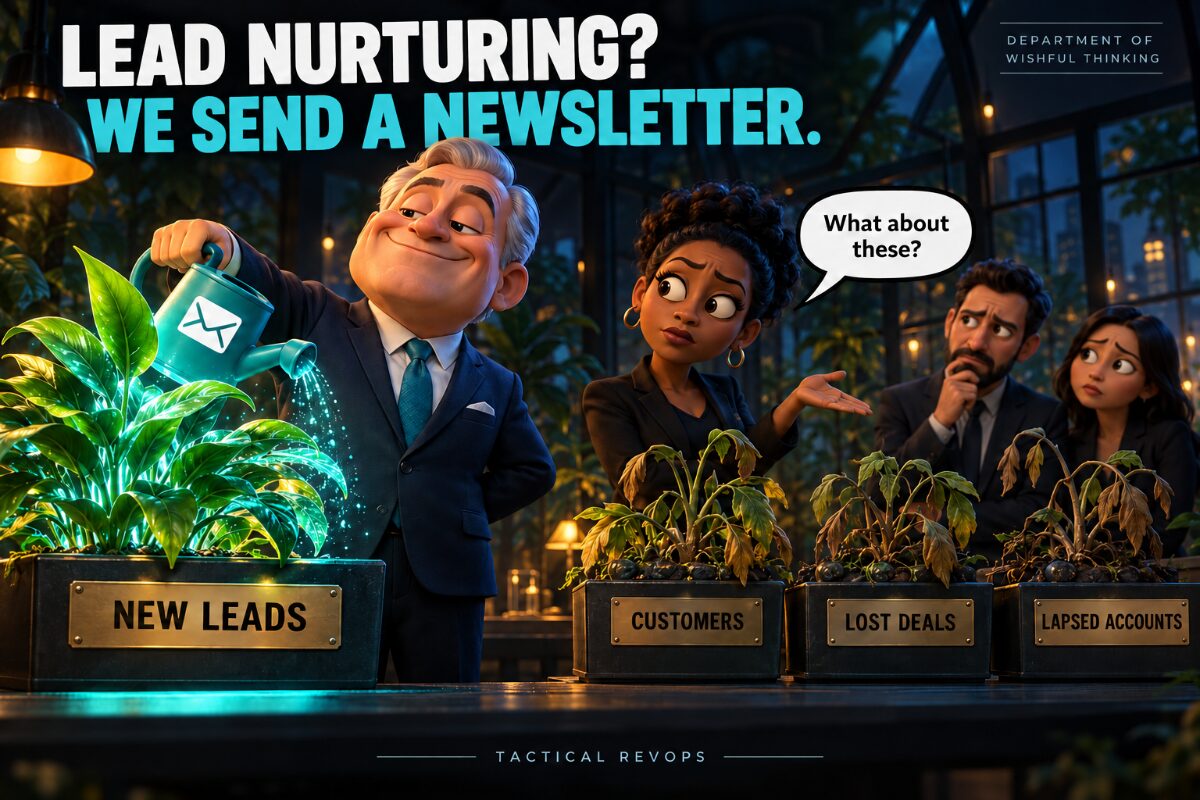
You have a newsletter. You upload the trade-show contacts. Maybe you have a welcome sequence that sends a few emails after someone downloads something. Great. But what happens next?
Not just after someone requests a meeting. What happens when they receive every email and never respond? What happens when they become a customer? When you lose the deal? When a customer stops buying—or your company acquires a business that offers something else they could use?
If the answer is “they keep getting the newsletter,” you may have a mailing schedule. You haven’t necessarily built a nurture strategy.
Nurturing should help people understand a relevant problem, evaluate their options, get value from what they already bought, or recognize when another conversation makes sense. Email can support that work. Sending more of it isn’t the objective.
For a small B2B business, this doesn’t require a sophisticated marketing team or dozens of automated workflows. Start with three practical decisions: who belongs in the audience, what they need, and what happens when the communication works—or doesn’t.
1. Get enough information to make the message relevant
Earlier in my career, I thought entering contact details into the CRM was annoying. Name. Title. Email. Phone number. I knew the person. I knew how to reach them. Why did I need to put all of it in another system?
I understand the sales rep’s perspective. It feels like administrative homework when you’re trying to get actual work done.
But now I see what missing information prevents the rest of the business from doing.
Marketing can’t reliably tailor a message to someone’s role if nobody captured their title. It can’t reach the right person without a current email. And it can’t build a useful audience if it doesn’t know the company, industry, location, or reason someone might care.
Segmentation starts with the differences that change the message:
- Industry: What problems, constraints, and applications are relevant to this business?
- Location: Can you serve them, and are there regional considerations?
- Role: Are you talking to an owner, technical evaluator, purchasing manager, or end user?
- Need: What product, service, or problem brought them to you?
- Buying journey: Are they learning, comparing options, evaluating a proposal, or waiting for a future project?
An engineer comparing technical approaches needs different information from an executive deciding whether to fund the project. A prospect researching maintenance options isn’t in the same place as someone ready to discuss a service agreement.
Start with full name, current work email, company, and title or role. Add a useful phone number and LinkedIn profile where available. Capture the industry, location, interest, and buying context needed for the segments you actually plan to use. Don’t invent information to fill blanks, and don’t make every nice-to-have field a barrier to getting started.
You don’t need 47 segments. Pick a few distinctions your team can maintain and that genuinely change what you say.
Having an email address tells you where to send something. Segmentation helps you decide whether it’s worth sending.
2. Nurture more than new prospects
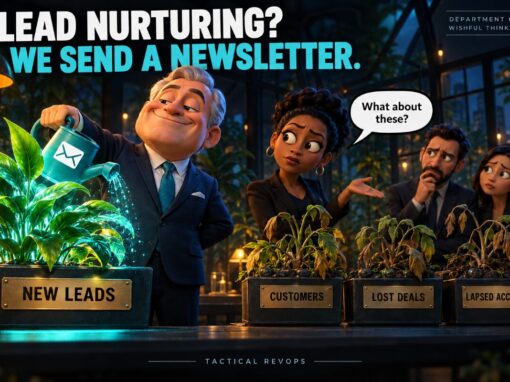
Lead nurturing often gets all the attention. Someone isn’t ready to buy, so you keep educating them until they are.
That makes sense. But your existing customers, lost deals, and lapsed accounts shouldn’t become an afterthought.
Different audiences need different communication:
- New prospects: Help them understand the problem, evaluate their options, and identify a sensible first step. Give them a reason to care before asking for a meeting.
- Existing accounts: Help them get more value from what they purchased and anticipate future needs. Stop introducing the service they already bought.
- Lost deals: Use the reason for the loss to decide whether—and when—another conversation makes sense. Don’t restart the same pitch regardless of why it failed.
- Lapsed customers: Learn what changed and offer a relevant reason to reconnect. A past purchase doesn’t mean today’s relationship is healthy.
- Cross-sell candidates: Connect a complementary offering to their current needs. Sending your entire catalog isn’t a cross-sell strategy.
Your customers shouldn’t have to become new leads again to get your attention.
3. Give nurturing a plan for success, silence, and when to stop
Most nurture programs have an entry point: a form submission, an event, a download, or a status change.
They also need exit strategies.
When someone responds, change the conversation
A purchase isn’t the only useful outcome. A question, a stated need, a request for help, or a reply explaining the timing gives you something to work with.
Make sure someone receives that response and knows what to do with it. Adjust the content, capture the timing, or coordinate an appropriate sales conversation. Pause an overlapping sequence where needed.
Don’t keep sending introductory emails after someone has told you their actual problem.
When they stay silent, investigate before sending more
Silence doesn’t explain itself. They may have no current need, be the wrong person, have changed jobs, or find your content irrelevant.
Before adding another email, check four things:
- Audience: Is this person still in a relevant role at a company you can help?
- Message: Are you addressing their problem—or repeatedly talking about yourself?
- Timing: Is there a known project, renewal, season, or other reason to reconnect later?
- Business context: Has sales or service heard from them? Silence toward marketing isn’t necessarily silence toward your business.
Getting interaction takes more than a brighter button or a stronger “Book a Call.” Give someone a reason to respond and make the response easy.
Ask a specific question about a known need. Share a practical resource and ask which issue is most relevant. Invite a customer to tell you what would make the service more useful. If you have a real business reason, have the account owner start a personal conversation.
“Are you still planning to expand the facility next year?” gives someone more to work with than “Just checking in.”
You can also ask what topics they want to hear about and how often. A simple preference option is enough to start; you don’t need an elaborate preference center. And don’t rely on opens or clicks alone to decide someone wants a sales conversation. Look for context and meaningful interaction.
When nothing changes, make a deliberate decision
Not everyone needs another nurture sequence. Sometimes the right move is to reduce frequency. Sometimes it’s to stop. When someone stays silent, choose what happens next:
- Retain at a lower frequency: They remain relevant and eligible for marketing, but have no immediate need.
- Move to a different nurture: New information changes their interests, timing, or buying stage. Moving them to another list won’t fix an irrelevant message.
- Coordinate personal outreach: There’s a specific business reason for a conversation—not simply an attempt to bypass their silence.
- Pause or suppress marketing: Their information is invalid, they’re no longer relevant, they opt out, or continued outreach isn’t justified.
The goal isn’t to force everyone to respond. It’s to stop treating indefinite sending as a strategy.
Start with one audience—not a giant automation project
Choose one group: customers buying a particular service, lost projects with delayed funding, or prospects in an industry you serve well.
Confirm who belongs in it. Identify what would be useful to them. Give someone ownership. Decide what counts as a meaningful response and what you’ll do if it never arrives.
Then review what you learned and improve the next round.
A nurture program needs more than an entry point. It needs a plan for success, silence, and when to stop.
Tactical RevOps helps growing B2B businesses turn scattered data and disconnected processes into practical commercial operations. If your nurturing begins and ends with “send the newsletter,” let’s work out what should happen next.